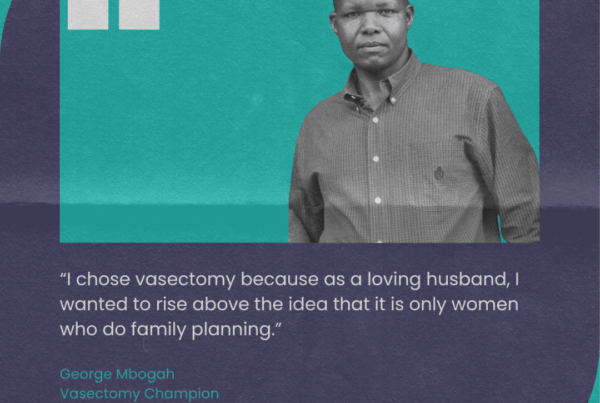
There’s a moment many couples face, yet few men openly discuss.
Maybe, they’ve had 2-3 children and feel their life is full, busy, and meaningful, and sometimes overwhelming. And this question surfaces quietly, *”So… what’s our plan for birth control?” *
More often than not, the answer defaults in a familiar direction. She continues managing contraception, schedules her appointments, absorbs the side effects, and carries the responsibility. Not because it’s the best option, but because it’s the expected one.
That pattern tells us something important. Even in committed relationships, even among thoughtful and engaged fathers, contraception is still largely treated as a woman’s domain. And that has less to do with biology than with how our health systems and our norms are structured.
Vasectomy offers a chance to rethink that.
A Method We Don’t Fully Use
Vasectomy is one of the safest and most effective forms of contraception available. It is a minor outpatient procedure with failure rates well below 1%, low complication risk, and significantly lower cost and invasiveness than female sterilization.
And yet, it remains underutilized.
In the United States, the numbers solidify the story above. Only about 6.8% of men ages 18–49 have had a vasectomy (Sayers, 2024). In contrast, 15.5% of women in the same age range rely on female sterilization (Daniels, 2020). In other words, even when a permanent solution is appropriate, women are still far more likely to carry that responsibility.
Zoom out globally, and the gap becomes even clearer. Female sterilization is the most widely used contraceptive method, accounting for about 23–24% of contraceptive use among women worldwide (U.N, 2019). Meanwhile, vasectomy remains rare in many low- and middle-income countries with a prevalence of approximately 0.9% with ratios of female to male sterilization (permanent methods) reaching as high as 13 to 1 in 2019 (Jacobstein et al., 2023). Even though the female procedure is more complex and carries greater clinical risk (Shand, 2024), women continue to shoulder most of this burden.
That imbalance is not simply about individual choice. It reflects a deeper pattern in how responsibility for reproductive health has been distributed.
Relational Masculinity and Shared Responsibility
This is where the concept of relational masculinity becomes useful.
Relational masculinity starts from a simple premise: men’s health decisions don’t happen in isolation. They are shaped through relationships with partners, children, and families. Responsibility, in this context, is not just about individual action. It is about how men show up in shared decisions that affect others.
Vasectomy is one way (though not the only way) that men can participate more fully in those decisions.
For a father who knows his family is complete, choosing a vasectomy can be less about the procedure itself and more about what it represents: a willingness to take on part of the physical and logistic responsibility that has historically fallen elsewhere.
Not as a sacrifice. Not as a statement. But as alignment of values and action.
What the System Makes Easy, and What It Doesn’t
But if vasectomy is such a strong option, why isn’t it more common?
Part of the answer lies in policy.
In the U.S., access to vasectomy is shaped by a set of rules that, often unintentionally, make it harder for men to act on this kind of responsibility. The most cited example is the Medicaid 30-day waiting period for sterilization. Originally designed to protect against coercion, it now functions in many cases as a barrier—particularly for low-income men who are ready to make a decision but cannot navigate the required timeline or paperwork.
I’ve heard versions of this story repeatedly: a couple decides, together, that a vasectomy makes sense. They try to schedule it around work, childcare, or the birth of a new child, and then realize the system isn’t built to accommodate that decision. They wait more than 30 days, feel like their life is too busy to jump back into that process, and then the opportunity passes.
Beyond Medicaid, coverage itself is inconsistent. While female contraceptive methods are broadly covered under federal mandates, vasectomy is often but not always included to the same extent. That means some men face out-of-pocket costs, limited provider options, or administrative friction that discourages follow-through.
As outlined in recent policy analyses from the American Institute for Boys and Men, this is not a marginal issue; it is a men’s health equity gap. The system does not consistently treat men as clients in sexual and reproductive health care. When men are not centered as clients, even highly effective options like vasectomy remain underutilized. And, this gap places a continued contraceptive burden on women.
A Missed Public Health Opportunity
From a public health standpoint, this matters.
Increasing appropriate uptake of vasectomy among men who have completed their families could:
- Reduce unintended pregnancies
- Lower overall health system costs
- Decrease reliance on more invasive procedures
- Redistribute the burden of contraception more equitably
At the same time, it would signal something broader: that men are expected to participate actively in reproductive health, not just support it from the sidelines.
It is also worth acknowledging that vasectomy exists within a constrained landscape.
Men currently have very few contraceptive options. While women can choose from a wide range of methods, male contraception has seen relatively little innovation on the open market. Efforts to expand options, through both hormonal and non-hormonal methods are underway, supported by organizations like the Male Contraceptive Initiative, but progress is steady but slow.
In that context, vasectomy plays a dual role. It is both a highly effective existing option and a reminder of how limited the broader method mix remains for men.
In Practice We are Expanding Responsible Fatherhood
For many couples, the decision is not abstract. The conversations happen at the kitchen table, sometimes after a second or third child. In quiet moments where both partners recognize that continuing the status quo may not make sense.
Sometimes vasectomy is the right answer. Sometimes it isn’t. But what matters is that it is had with accurate information on the table, each person understands the implications, the man can get the procedure, and they arrive at this decision together. Vasectomy invites a broader question: what does responsibility look like when it comes to reproductive health?
If fatherhood is about long-term commitment, care, and partnership, then responsibility includes being informed about options, engaging in open conversations, and, when appropriate, taking action.
For some men, that action may be a vasectomy. For others, it may take a different form.
The goal is not uniformity. It is participation.
Starting the Conversation
The most meaningful shift may not come from policy alone or from individual decisions in isolation, but from conversations. Conversations between partners, normalizing reproductive health with friends and children, and clinical conversations between providers and patients. Within systems that have historically overlooked men as reproductive health clients.
This Father’s Day, vasectomy doesn’t need to be the conclusion.
But it should be part of the conversation.
- Shand T, Evoy C. Out Of Focus: The representation of men in regional and global sexual and reproductive health policy. Global Action on Men’s Health. London, 2024. https://gamh.org/wp-content/uploads/2024/08/Sexual_Health_Report_SEPT24FINAL.pdf
- American Institute for Boys and Men. (n.d.). Vasectomy access is a men’s health equity issue. https://aibm.org/commentary/vasectomy-access-is-a-mens-health-equity-issue/
- American Institute for Boys and Men. (n.d.). Policy options to improve insurance coverage of vasectomy. https://aibm.org/policy/policy-options-to-improve-insurance-coverage-of-vasectomy/
- Male Contraceptive Initiative. (n.d.). Male contraception research and advocacy. https://www.malecontraceptive.org/
- Daniels, K. (2014). Current Contraceptive Status Among Women Aged 15-44;: United States, 2011-2013 (No. 2015). US Department of Health and Human Services, Centers for Disease Control and Prevention, National Center for Health Statistics.
- Jacobstein, R., Radloff, S., Khan, F., Mimno, K., Pal, M., Snell, J., … & Tripathi, V. (2023). Down but not out: vasectomy is faring poorly almost everywhere—we can do better to make it a true method option. Global Health: Science and Practice, 11(1).
- United Nations. (2019) Contraceptive Use by Method: Data Booklet. Population Division, (ST/ESA/SER.A/435), New York: UN: Department of Economic and Social Affairs 2019.
- Sayers, J. T. (2025). Vasectomy in Men Ages 18–49 in the United States, 2022–2023. NCHS Health E Stats [Internet].