Declining birth rates have sparked fears of a fertility “crisis” and population “collapse.” The fears are based on misinformation, but nonetheless generate reactionary pronatalist policies aimed at boosting birth rates. They range from baby bonuses to abortion bans, and from right-wing restrictions on reproductive rights to so-called progressive pronatalism purporting to help people achieve their desired (larger) family size.
But it’s fallacious to argue falling birth rates spell disaster. On the contrary, global population growth is continuing, projected to exceed 10 billion by the 2080s, driving more consumption, and unleashing disastrous ecological and social consequences.
There is no conclusive evidence that declining birth rates indicate unfulfilled desires for more children. On the other hand, there is plenty of evidence that greater reproductive choice is empowering people to delay parenthood and have fewer or no children.
So why all the panic about declining birth rates? Lack of demographic literacy together with deeply rooted pronatalism has helped the spread of misinformation and misunderstanding.
While it’s true the US “total fertility rate” (TFR) dropped from 2.08 in 1990 to 1.6 in 2024, it’s a misconception that this indicates Americans are having fewer children than they want.
TFR looks at the fertility rate of different age cohorts and assumes, for example, that people in their 20’s today will mirror the fertility behaviors of 20-somethings in 1990. But today’s 20-somethings increasingly choose to delay having children. They are early in their reproductive years, and taking a snapshot of their reproductive behavior makes fertility rates seem lower. By segmenting different cohorts, TFR artificially inflates the gap between fertility intentions and realised fertility. That’s why leading demographers argue that policymakers should not rely on TFR but rather use the “completed cohort fertility” (CCF).
CCF is the measure of the total number of children people have in their lifetime, on average. In the US, it has hovered around 1.9-2.0 since 1990, declining only slightly. Much of that decline points to fewer teenage pregnancies, a shift to smaller family sizes, and more people not wanting any children.
In most countries, CCF decline is not as dramatic as the decline in TFR, and is primarily driven by greater reproductive autonomy, which we should embrace.
Right-wing pronatalists like Stephen Shaw and Lyman Stone and even some progressives claim people aren’t having as many children as they would like to have. They advocate higher birth rates in order to change that. But they are misreading the data.
The US and many other countries use poorly designed General Social Surveys that ask people about their “ideal” size of a hypothetical family, rather than their “desired” family size or whether they’re satisfied with the size of their actual family. In addition to leading to spurious conclusions, these flawed survey designs undercount people who are childfree by choice, who make up a staggering 21.6% of all US adults.
It’s a common mistake to misinterpret survey data as evidence people are having fewer kids than they want, and that mistake is used to justify reactionary pronatalist policies. These policies don’t work. Even the most generous ones—paid parental leave, childcare, and healthcare—haven’t raised birth rates. That suggests that people having fewer or no children are doing so by choice, not necessity.
Birth rates are falling in most industrialized countries for many reasons. In more gender-equal countries like Denmark, Finland, and Norway, supportive policies, combined with a lack of stigma, allow single, childfree, childless, and non-heterosexual people to pursue non-traditional life paths. At the same time, family-friendly policies that promote equal participation among parents in childcare and work responsibilities lead to smaller and more child-centric families.
In more patriarchal countries like Japan and South Korea, which rank among the lowest in the OECD for gender equality, women’s social status remains very low despite high educational attainment, and they shoulder disproportionate responsibility for housework and childcare. The high personal and financial cost leads many to forgo marriage and children.
It’s important to address barriers to becoming a parent, whether it’s infertility, high costs, motherhood penalty for working moms, or stigmas surrounding engaged fatherhood.
But obsessing over reversing fertility decline won’t help with any of that. It misdirects attention away from the subjugation of hundreds of millions of girls and women on whose backs the population is still growing. It leads to simplistic and ineffective policies that undermine liberated and responsible reproductive choices, including the choice to remain single or childfree.
On the contrary, pronatalism exerts intense family pressure on women to bear children or grandchildren. In many places, those who won’t or can’t comply are often subject to domestic violence, divorce, and social stigma. Religious pronatalism treats parenthood as an obligation and often propagates misinformation about contraceptives, vasectomies, and abortion. Nationalist and nativist pronatalism underpins such policies as baby bonuses, tax incentives for large families, abortion bans, stricter divorce laws, and laxer domestic violence laws. Economic pronatalism seeks to grow the population to feed an economic system dependent on endless growth.
The various pronatalist agendas serve to erode hard-won freedoms and restrict access to education and reproductive healthcare services, resulting in millions of unwanted pregnancies and unsafe abortions each year.
We live in a time of profound ecological overshoot resulting from unchecked population and consumption growth, which together are driving climate breakdown, biodiversity loss, resource scarcity, and more. Slower population growth and, ultimately, population decline—would be good for people and the planet, but not for those in power, who for millennia relied on women’s reproductive labor to produce more workers, consumers, religious followers, taxpayers, and soldiers. Hence the rise in reactionary pronatalism.
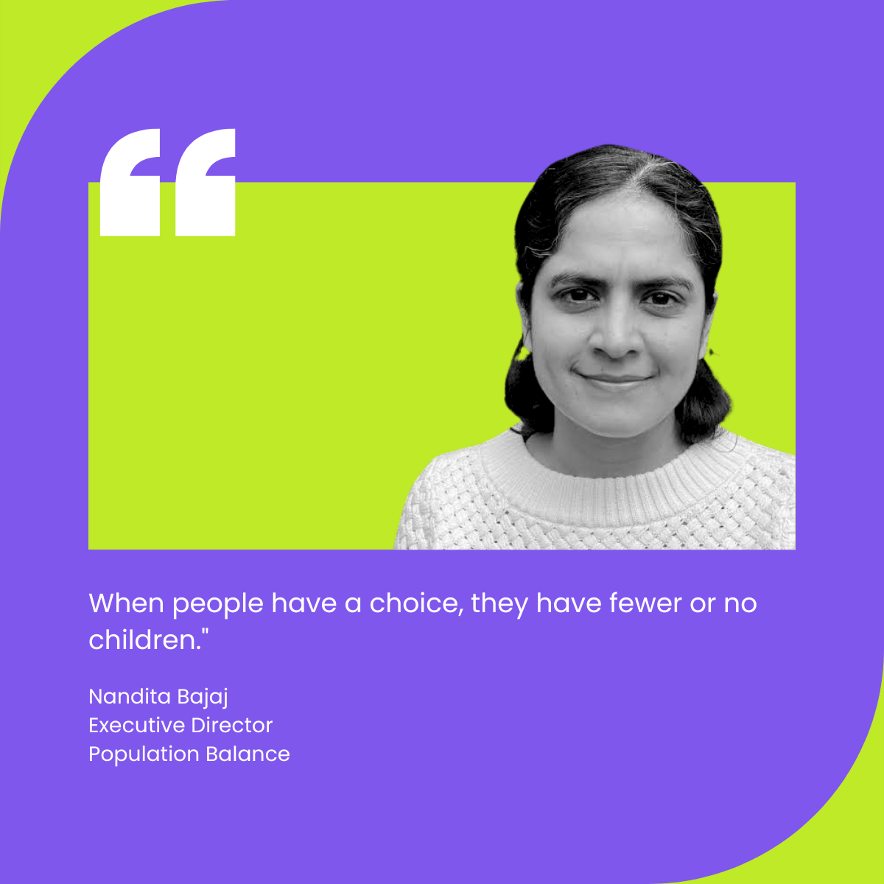
The choice about if and when to have (a) child(ren) should be made freely, mindfully, and responsibly, not constrained by ideological or policy pressures that treat having children as a locus of political or economic power. In general, when people have a choice, they have fewer or no children. We must urgently shift away from pronatalism and towards a framework of justice and care that advances the right to self-determination, education, dignified and meaningful work, a strong intergenerational safety net, and a livable planet.